The BCI Battery Poster Research Showcase is open to undergraduate, graduate, and postdoctoral level researchers and assistants to share their latest work during the BCI Convention + Power Mart Expo each year.

About the BCI Battery Poster Research Showcase
Each year, students contribute to the scientific community’s research of battery innovations during the BCI Battery Poster Research Showcase as part of the annual BCI Convention + Power Mart Expo.
This poster experience is intended to support researchers in university, governmental and commercial settings in building awareness about the scientific opportunity and objectives of careers in battery technology, preferably with a focus on lead, and to share cutting-edge science and technology across this critical industry.
To participate:
- Researchers must submit a submission form, a project abstract, and prepare a poster for display at the BCI Convention + Power Mart Expo
- For more information on applying, please email info@batterycouncil.org
- Deadline for submissions is January 31 each year
- Applicants are notified of acceptance by the end of February and must confirm participation by the end of March
- The BCI Poster Research Showcase awards will be announced during the annual BCI Convention + Power Mart Expo
- View past poster contest winners.

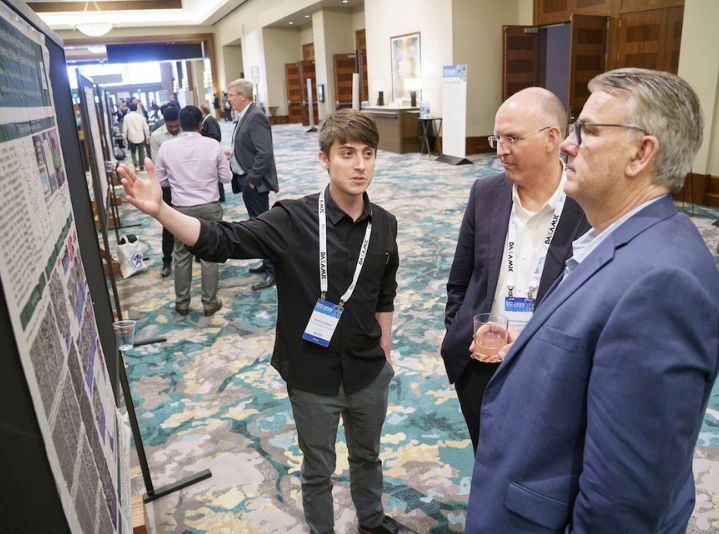
Showcase Your Research on the Industry’s Biggest Stage
- Researchers must submit a submission form, a project abstract, and prepare a poster for display at the BCI Convention + Power Mart Expo
- Deadline for submissions is January 31 each year
- Applicants are notified of acceptance by the end of February and must confirm participation by the end of March
- The BCI Poster Research Showcase awards will be announced during the annual BCI Convention + Power Mart Expo
- Showcase your project and network to attract resources including potential funding
- Explore and learn from industry innovations
- Collaborate and brainstorm with academics
- View past poster contest winners. For more information on applying, please email info@batterycouncil.org
“The showcase was a fantastic platform for sharing ideas and sparking insightful conversations with professionals from diverse backgrounds. Overall, it’s a must-attend for anyone in our field looking to expand their knowledge and connect with like-minded peers.”
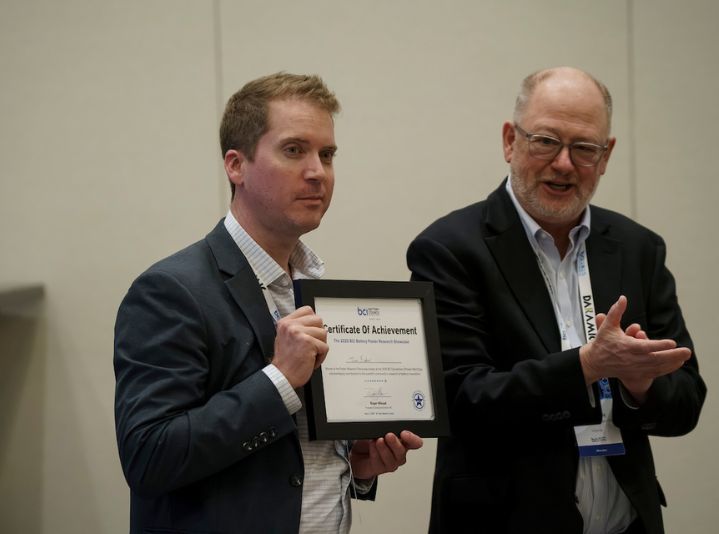
Acoustic Characterization of Lead Acid Batteries
Tim Fister, Argonne National Laboratory, 2025 Winner
Local variation in electrode and electrolyte composition contributes to large-scale changes in overall utilization and cycle life of lead acid batteries. Here, we outline the potential for ultrasonic characterization of lead acid batteries to diagnose local changes in state of charge (SOC) and state of health (SOH). Using 2V cells constructed with commercial battery plates, we show that the amplitude and time-of-flight of ultrasonic signals is highly sensitive to changes in the bulk modulus and density of lead battery materials and acid specific gravity during cycling.
Using high-rate partial state of charge cycling, we also show that these changes can be used to track the onset of sulfation on the negative electrode. This nondestructive, analytical tool can provide crucial feedback for emerging battery management systems and could potentially be used for quality control measures during manufacturing.
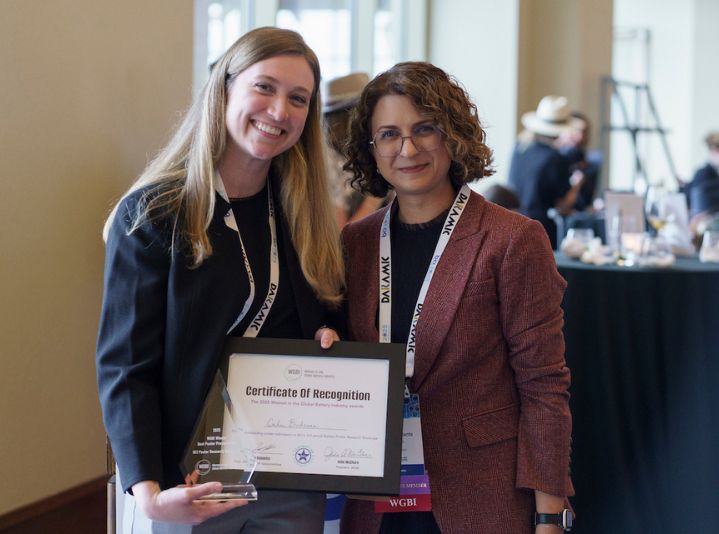
Accelerating Redox Flow Battery Development Through an Autonomous Flow Battery Cycler Station
Cailin Buchanan, Argonne National Laboratory, 2025 WGBI Winner
Redox flow batteries (RFBs) are a promising technology for long duration energy storage (LDES) because of their theoretically long cycle life and scalability. Although the state-of-the-art RFB is vanadium-based, it is not economical due to vanadium’s price volatility and low voltage. Thus, RFBs with alternative electrolytes must be explored. Organic RFBs are attractive due to their low-cost, earth-abundant materials, however, many systems suffer from poor stability and low energy density. Given the vast parameter space for RFB electrolytes, including active materials and supporting electrolytes, the pace of research urgently needs to be quickened to identify systems that are stable and have high energy densities. To accelerate the development of RFBs, we have built an automated flow battery cycler station that can explore a large parameter space and leverage artificial intelligence (AI).
The automated platform contains sixteen electrochemical testing channels, each comprised of four peristaltic pumping channels and four selector valves that deliver electrolyte to the flow cell. One software controls both the electrolyte delivery system and the electrochemical testing, resulting in complete automation and closed-loop capabilities. To test the automated station, we collected electrochemistry results for commonly proposed redox active materials like hydroxy-TEMPO (2,2,6,6-tetramethyl-1-piperidinyloxy) and supporting salts like lithium bis(trifluoromethanesulfonyl) imide (LiTFSI). The automated system was used to explore a wide range of supporting salt concentrations without human intervention, underscoring the utility of the cycler station and its potential for use in an autonomous discovery platform to accelerate LDES technology development even further when coupled with machine learning optimization algorithms.


There's a lot of room for growth in ... lead battery chemistry ... it's something that would really make it even more competitive for things like stationary storage.